

If you're launching a SaaS today, the first roadblock you hit is almost always the same: yourname.com is taken.
You are then faced with a choice that feels consequential: Do you spend $5,000 to buy the .com from a squatter? Do you settle for .io? Or do you jump on the trend with a .ai domain?
This isn't just about aesthetics. Your domain extension affects trust, click-through rates, and your budget. This guide will help you decide without getting stuck in "analysis paralysis."
Quick Decision Tree
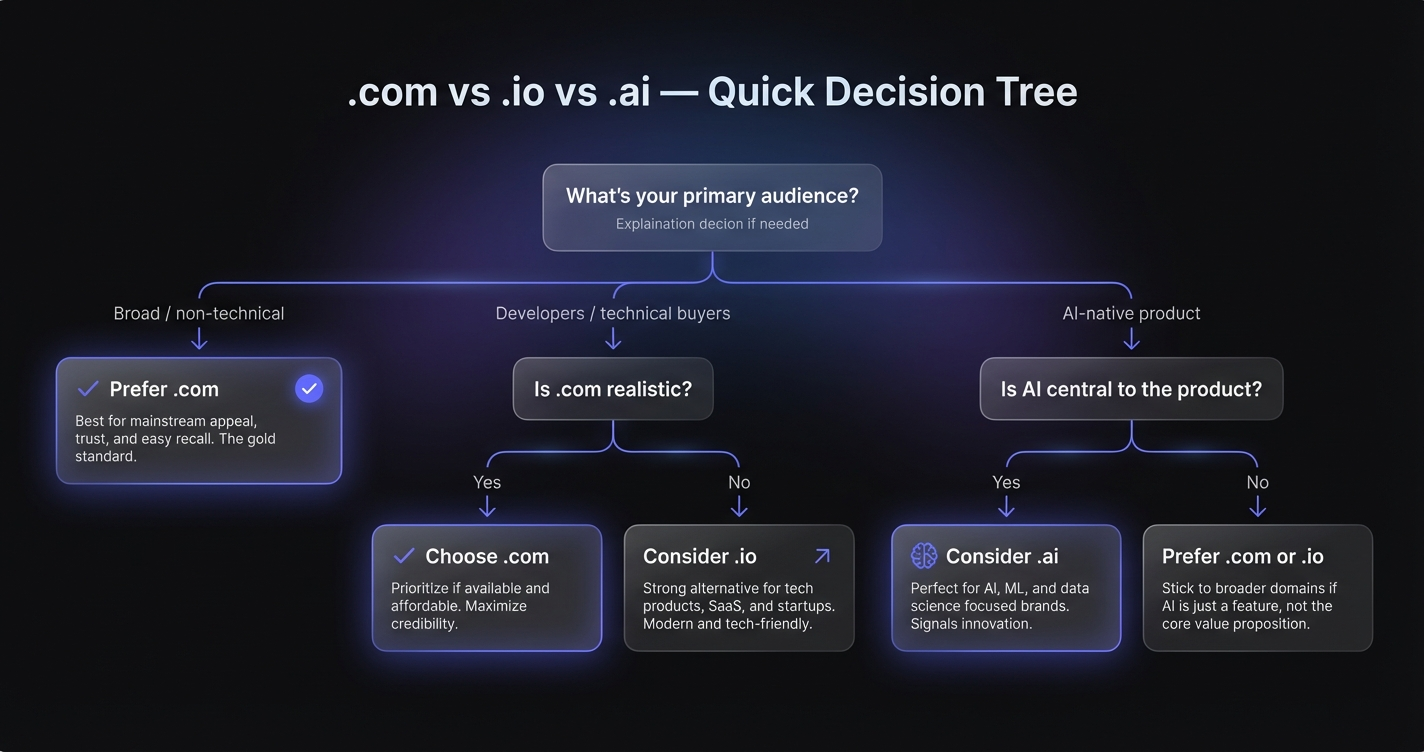
If you want the shortcut, here is the rule of thumb for 90% of startups in 2025:
- The Gold Standard: If you can get the
.com(even with a small modifier), get it. - The Tech Standard: If you are selling to developers or B2B SaaS,
.iois completely safe and accepted. - The Specialist: If your product's core value proposition is Artificial Intelligence,
.aiis a powerful branding signal.
1. The Heavyweight Champion: .com
Even after 30 years, .com remains the king of the internet. It is the "default" extension that non-tech people assume every website uses.
Pros
- The Radio Test: If you tell someone your website name on a podcast, they will intuitively type
.com. - Trust & Authority: It signals that you are an established business, not a fly-by-night project.
- Resale Value: A good
.comis a digital asset that holds value.
Cons
- Scarcity: Most good one-word and two-word names are gone or cost six figures.
- Price: You might have to pay a premium (thousands of dollars) just to acquire it.
When to fight for it
If you are building a consumer app (B2C) or a marketplace where you need trust from non-technical users (e.g., your mom or a local dentist), .com is worth the extra effort. If your exact name is taken, try a "modifier" prefix or suffix:
get[name].comuse[name].comtry[name].com[name]hq.com(very popular for B2B)[name]app.com
2. The Tech Darling: .io
Originally assigned to the British Indian Ocean Territory, .io was co-opted by the tech community because I/O stands for Input/Output. It is now the de-facto standard for startups, dev tools, and SaaS.
Pros
- Availability: You have a much higher chance of finding
[yourname].ioavailable for registration price (~$30-$60/year). - Signal: It immediately signals "we are a tech company."
- Community: Developers trust it implicitly.
Cons
- Weak outside tech: If you are selling accounting software to traditional small businesses, they might be confused by the ending.
- Politics: There are occasional concerns about the geopolitical status of the territory, though this rarely impacts business operations.
When to choose it
If you are a B2B SaaS, especially one selling to other startups, marketers, or developers, .io is a fantastic choice. It is clean, short, and professional.
3. The New Cool Kid: .ai
With the Generative AI boom, .ai domains have exploded in popularity and value. Originally the country code for Anguilla, it is now synonymous with Artificial Intelligence.
Pros
- Relevance: It tells the user exactly what you do before they even visit the site.
- Prestige: Right now, it sounds cutting-edge and modern.
- Availability: Better than
.com, though good names are disappearing fast.
Cons
- Expense: Registry prices are high (often $70-$150/year renewals).
- Niche Risk: If you pivot away from AI features later, your domain might feel misleading.
- Trend Fatigue: Like
.cryptoor.web3domains, there is a risk that it might feel "dated" if the hype cycle crashes (though AI utility seems here to stay).
When to choose it
Only use .ai if AI is central to your product. If you just have a small "AI assistant" feature in a larger HR platform, stick to .com or .io. Don't dilute the brand promise.
The "Good Enough" Alternatives
If your heart is broken because .com, .io, and .ai are all taken, don't panic. There are other respectable tiered options:
- .co: The most common alternative to
.com. It's safe, but users often typo it as.com. - .app: Owned by Google, it requires HTTPS (security) and is great for mobile-first web apps.
- .dev: Perfect for developer tools and open-source projects.
- .net: a bit dated, giving off "1990s ISP" vibes. Avoid for modern SaaS unless you have no choice.
- .org: Strictly for non-profits and open-source. Do not use for commercial SaaS.
The SEO Question: Will my extension hurt my ranking?
This is the most common myth. Google treats .io and .ai (and .co) as Generic Top-Level Domains (gTLDs).
This means they are not geographically penalized. You can rank globally with a .io domain just as easily as with a .com.
However, SEO is also about Click-Through Rate (CTR). If a user sees a search result for legal-advice.ai vs legal-advice.com, they might be more hesitant to click the .ai link for sensitive legal matters. For "cool tech tools," the .io link might actually get more clicks. Match the extension to your audience's expectations.
Conclusion: Stop Thinking, Start Building
The name matters, but the product matters more. Facebook.com started as thefacebook.com. Dropbox.com started as getdropbox.com.
Don't let a domain search stop you from launching.
- Make a list of 5 ideas.
- Check if the
.comis buyable or modifiable. - If not, check the
.io(for SaaS) or.ai(for AI tools). - Buy one and get back to coding.
Need ideas fast?
Stop guessing what's available. Use our Domain Finder & Idea Generator to brainstorm catchy names and check availability across .com, .io, and .ai instantly.
Want name ideas with instant domain checks?
Try the AI domain name generator